The time to vote for or against Scottish independence is creeping ever
closer. With less than a week until the big ballot day, big names from Rita Ora
to Sir Sean Connery are actively highlighting their views on the matter to sway
voters. So the question is, what will life be like in Great Britain if Scotland
becomes autonomous on 18th September?
According
to a new poll, 53% of people will vote for Scotland to stay in the U.K. in next
week's independence referendum. If the majority of Scotts were to vote Yes,
their government has a set a date 18 months from now, 24th March 2016
for their official independence day.
There would be amendments made to the constitution and the 1707 Act of Constitution
would be dissolved but the Queen would remain as monarch of the country. It’s
also been said that the Queen has been privately concerned over the referendum,
and as for the 2015 General Election, Scotland would still be invited to take
part, but their representatives would only potentially serve a 10-month term in
office.
Whichever way the poll sways, it’s still yet to be decided what currency
Scotland would employ if they separated from the rest of Great Britain. The three main
Westminster parties - the Conservatives, Labour and the Liberal Democrats have
ruled out a currency union, although Mr Salmond, Scotland’s First
Minister insists an independent Scotland would keep the pound, take on the Euro
or retain their own Scottish pound exclusively. Moreover, in terms of national
debt, it’s also yet to be decided how much of the UK national debt would be transferred to Scotland. It’s likely to be
worked out on a per capita share based on population.
Additionally,
an independent Scotland’s stance on global affairs is yet to be negotiated. The
nation would have to negotiate its own entry into the European Union and NATO
and with regards to the issue of defense, the strategy is not yet certain if
Scotland were to be a standalone country. As NATO is fundamentally a nuclear
alliance, and if Scotland struggles to become a member, they are likely struggle
to join the EU too, which would have a big impact on their economy. They are
likely to have their own defense force, particularly because they have their
own North Sea oil and fishing industries to maintain and protect.

Immigration
is undoubtedly an immense problem in Great Britain currently, but it’s already
been decided that an independent Scotland would control its own borders.
However, the Scottish National Party (SNP) aspires to have an open border policy
but Home Secretary Theresa May has already warned she will not allow Scotland
to be used as a way for immigrants getting into England if Scotland adopts a
looser immigration policy.
The
laws surrounding passports depend almost entirely on whether Scotland joins the
EU; Scottish citizens would be entitled to a Scottish passport, but a UK
passport would still be valid until it expires. British citizens who were
habitual residents in Scotland would be automatically considered Scottish
citizens.
State
taxes and benefits would become the responsibility of the new Scottish
government, meaning they could potentially create their own policies, and with
this and so much else to consider before the poll, it’s easy to see why many
English politicians, including David Cameron and pushing the No Campaign. However, Mr Cameron has insisted his sudden
boost in interest in the referendum is not due to a lack of support in recent
polls and that he will not be resigned as Prime Minister not matter the outcome
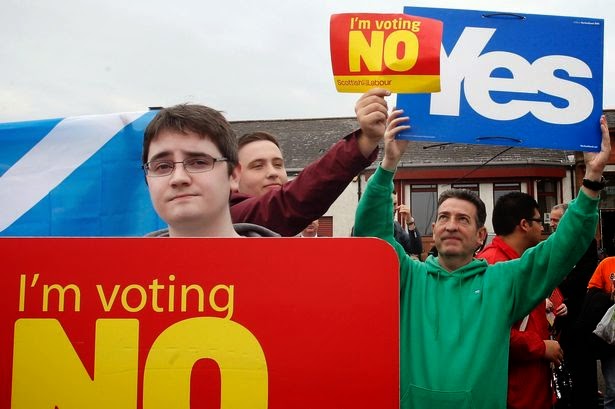
of the vote. Some have even argued that the announcement of a second royal baby
was tactically revealed to sway voters to remain faithful to the unity of Great
Britain.
Furthermore,
Royal
Bank of Scotland (RBS) has
drawn up plans to shift its Head Office from Scotland, where it has been based
since 1727, most likely to Central London, in the event that next week's
referendum backs a break away from the rest of the UK. On the other hand,
one of the North Sea’s biggest investors, BP has urged Scotland to vote against
independence, arguing that oil wealth
would best be protected by remaining inside the UK.
Scotland’s education system has always been distinct from the rest of the UK, but
the future of the country’s schools and universities is still a key issue in
the independence debate. Questions have
been raised about tuition fees, research grants, overseas students, teacher
recruitment and exam options as the Yes and No campaigns battle it out and with
four universities based in the Capital, Edinburgh has a special interest in
what independence might mean for higher education.
Whatever the final verdict come 18th
September, Scottish and British politicians alike have a great deal of negotiation
and debate ahead of them in order to decide how to lead their nations if they
do their separate ways. Many aspects of British life are up in the air, but it’s
only a matter of time before questions about the vote will be answered.


